

The Language Services Blog | News & Information

Marketing Localization for Product Launches: A Pre-Launch Checklist
Most launch calendars give localization one line: "Translate assets, week six." That single line hides a dozen decisions about markets, names, claims, and review. Marketing localization works when teams make those decisions early, not in week six. This guide lays out a pre-launch timeline in six phases, from choosing markets to reviewing results after launch. Adjust the weeks to fit your own calendar. The order matters more than the exact dates. Marketing localization works best when planning starts months before launch. Why Marketing Localization Needs Its Own Timeline Marketing localization doesn't start when the English assets are final. By then, the team has already made the decisions that shape it: which markets to enter, which tone to use, and which product names to keep. Treating it as a late-stage translation task compresses review time. It also hides problems until launch week, when nobody has time to fix them. A separate timeline pulls those decisions forward, where they cost less. What Counts as Marketing Content Marketing localization covers more than the landing page. Each content type has its own risks, and each one needs a place on the timeline: Landing and product pages. Layouts must absorb longer text, and calls to…
October 13, 2026
Our Recent
Blogs
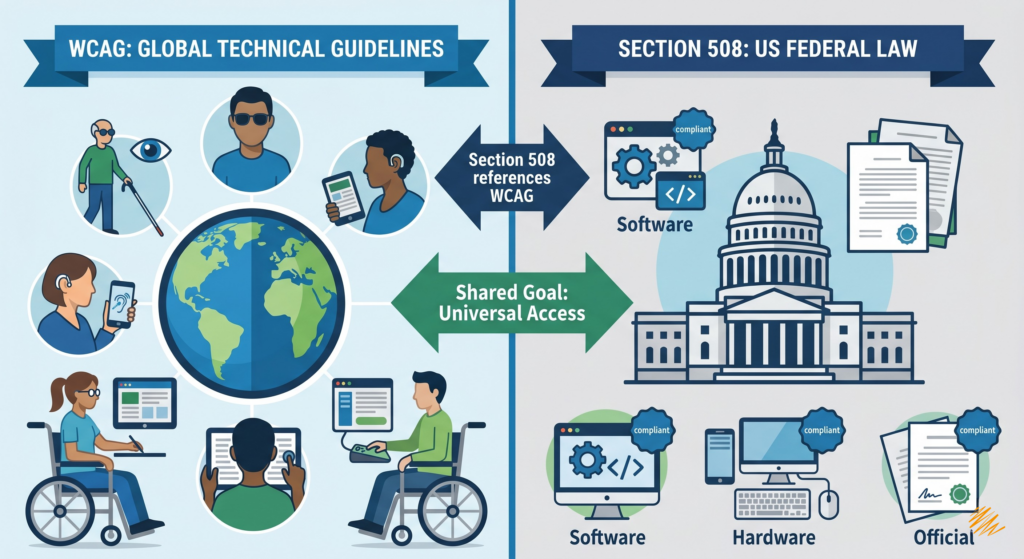
By the Translationary Editorial Team | 6 Min Read | Category: [ Digital Accessibility, Compliance ] As organizations expand their digital presence, accessibility is becoming just as important as translation, localization, and user experience. More than 1.3 billion people worldwide experience significant disability, and accessible digital content helps more people navigate, understand, and use what you publish online. When teams begin looking into digital accessibility, two terms come up almost immediately: WCAG and Section 508. They are closely related, but they are not the same thing. WCAG is a technical standard. Section 508 is a U.S. legal requirement that applies to covered federal information and communication technology. At Translationary, we see accessibility as an essential part of global communication. If your website, documents, or digital tools are not accessible, your message is still leaving part of the audience behind. Understanding the difference between WCAG and Section 508 is one of the first steps toward making informed accessibility decisions. What is WCAG? WCAG stands for the Web Content Accessibility Guidelines. Developed by the World Wide Web Consortium (W3C), WCAG is the technical standard for web content accessibility. It is not a law on its own, but it is widely referenced by…
May 7, 2026

By the Translationary Editorial Team | 3 Min Read | Category: [ Accessibility & Document Remediation ] PDFs are still widely used for reports, manuals, contracts, forms, and other business-critical documents. But a PDF that looks polished on screen can still be difficult or impossible to use with assistive technology. In accessible PDFs, structure matters: tags, reading order, real text, image descriptions, table markup, form labels, and language settings all help screen readers and other tools interpret the file correctly. Section508.gov, Adobe, and W3C all treat logical structure and tagging as foundational to PDF accessibility. At Translationary, we believe content should bridge gaps, not create them. Accessibility is not just a nice-to-have feature. It is a core part of inclusive communication, especially when documents are being shared across languages, formats, and audiences. If you want your PDFs to be usable by a wider audience, these are five of the most common accessibility issues to fix first. 1. Missing or Incorrect Tags and Reading Order Tags are the structural framework of an accessible PDF. They tell assistive technologies what is a heading, paragraph, list, table, image, or link, and they help preserve a meaningful reading order. When tags are missing, incomplete,…
April 27, 2026

By the Translationary Editorial Team | 4 Min Read | Category: [Accessibility / Document Remediation / Industry Insights] In global communication, translation is often the first priority. But there is another factor that is just as important: Digital Accessibility. At Translationary, we believe translation alone is not enough. If a technical manual is translated into French, Spanish, or Arabic but cannot be navigated by a screen reader or understood by assistive technology, the job is not complete. The difference between an inaccessible document and an accessible one is not just technical. It affects usability, compliance risk, and whether your content can actually be understood by the people it was meant to reach. What is an Accessible Document? An accessible document is a digital file, such as a PDF, Word document, or web-based file, that is structured so people with disabilities can perceive, navigate, understand, and interact with its content effectively. That includes users who rely on screen readers, keyboard navigation, captions, structured headings, sufficient contrast, descriptive links, and properly labeled tables, images, and form fields. A document may look polished on screen and still be inaccessible in practice. Accessibility depends not only on visual design, but also on the structure…
April 17, 2026

By the Translationary Editorial Team | 5 Min Read | Category: [Digital Accessibility / Document Remediation] You may have published a polished quarterly report, an employee handbook, a product manual, or a client-facing brochure. Visually, it looks complete. But if that PDF or Word file cannot be properly interpreted by a screen reader, navigated by keyboard, or understood by assistive technology, then it is not truly accessible. In that case, the document may look finished to some users while remaining functionally unusable to others. At Translationary, we know that translation alone is not enough. If a document is linguistically accurate but digitally inaccessible, the message still does not fully reach its audience. Accessibility and language access often need to work together. This matters at scale. The World Health Organization estimates that 1.3 billion people, about 16% of the global population, experience significant disability. Key Takeaways Why Document Accessibility Is Often Overlooked When organizations think about digital accessibility, they often focus first on websites and mobile apps. Documents are frequently treated as secondary assets. In practice, however, PDFs, Word files, spreadsheets, and slide decks often contain some of the most important information an organization shares, including policies, contracts, reports, manuals, forms, and public-facing resources. If those…
April 9, 2026
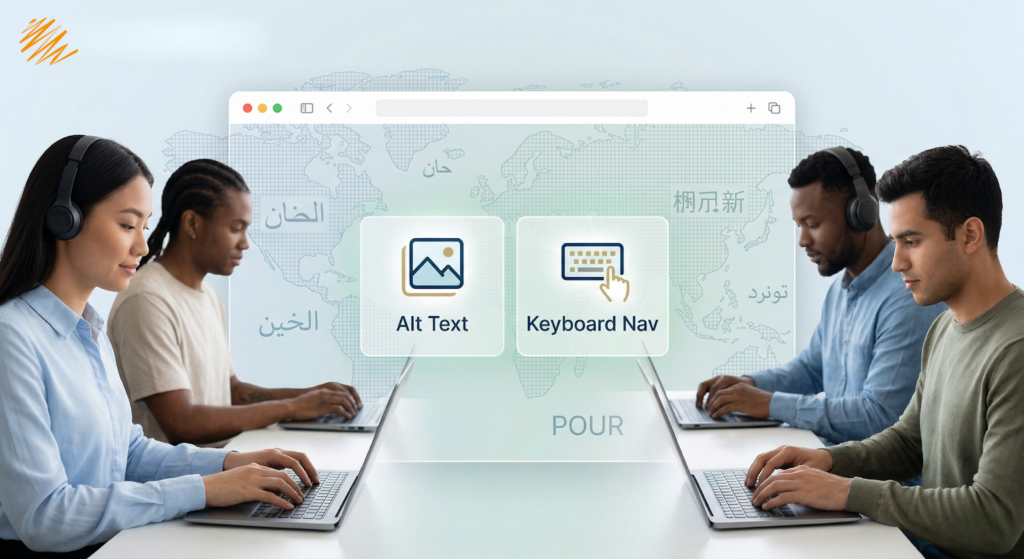
By the Translationary Editorial Team | 6 Min Read | Category: [Digital Accessibility / Compliance] Digital content is how the world works, shops, and learns. However, when websites and apps aren't designed with inclusivity in mind, they create invisible barriers. With 1.3 billion people worldwide (16% of the population) experiencing significant disability, accessibility is no longer a "nice-to-have"—it is a global necessity. At Translationary, we believe access should not stop at language. True communication means making digital content usable for everyone, including those relying on screen readers, keyboard navigation, and captions. What Is Accessibility Remediation? Accessibility remediation is the structured process of identifying and correcting digital barriers that prevent people with disabilities from fully accessing content. Whether it’s a corporate website, a mobile app, or a localized PDF, remediation ensures that your assets work seamlessly with assistive technologies. Common fixes include: The Global Standard: Understanding WCAG The Web Content Accessibility Guidelines (WCAG) are the gold standard for digital inclusion. The current W3C recommendation, WCAG 2.2, expands on previous versions to include focus appearance and target sizes. To make remediation easy to understand, the framework uses the POUR acronym: PrincipleMeaningPerceivableContent must be visible/audible (captions, alt-text, structure).OperableUsers must be able to navigate,…
March 31, 2026

As we step into 2026, one trend becomes clearer every year: audiences are more global, more diverse, and more connected than ever before. Yet many businesses still communicate as if the world speaks only one language. At Translationary, we see firsthand how language shapes trust, accessibility, and brand credibility. And looking at the data, multilingual content is no longer a “bonus”—it’s a core part of how modern companies grow. Here’s why it matters now more than ever. People trust content in their own language A major global survey by CSA Research found that 76% of consumers prefer to buy from websites in their native language, while 40% said they would not make a purchase if the site wasn’t available in a language they understood. That’s almost half of all potential customers lost because of language barriers. When people read content in their own language, the experience feels natural. There’s less confusion. More confidence. They connect with the brand more easily. And that sense of comfort directly affects engagement and conversions. Localization leads to higher conversions Translation is one piece of the puzzle. Localization—adapting content to fit local culture, tone, and expectations—has an even stronger impact. Some companies have reported up…
February 10, 2026