

Language and Content Solutions for a World Without Barriers
Connecting you to the world through expert language solutions. We bridge communication gaps, enhance global reach, and empower your business with seamless translation and localization services.

Translationary is more than just a language service; we are a comprehensive content lifecycle partner.


Transcription
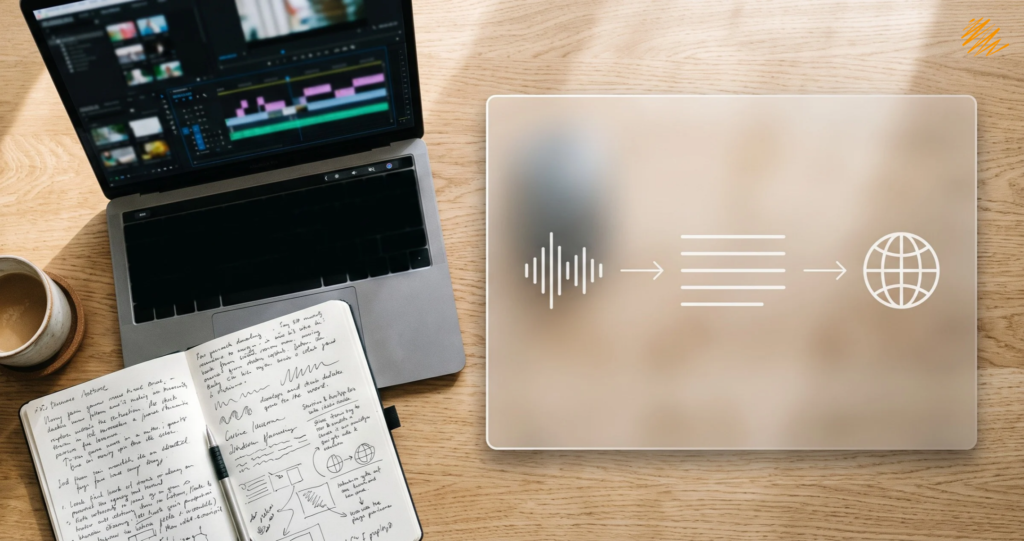
Turn audio and video into accurate, readable transcripts. Our transcription services help organizations document interviews, meetings, and research, making spoken content easier to review, share, and translate.
General Transcription
Accurate transcription ensures reliable translation and enhances the final document’s quality.
Audio Transcription
Audio transcription converts speech to text, enhancing accessibility and content usability.
Our Other Services

Translation
At Translationary, we enhance your communication with expertise in translating vital documents, interpreting key meetings, and engaging effectively in new markets.
EXPLORE MORE
Localization
Experience precise translations that ensure your message connects in any language, ideal for business documents, marketing materials, and personal correspondence.
EXPLORE MORE


Translationary Group
We specialize in language strategy, process optimization, and cutting-edge technology to ensure our clients receive exceptional, seamless service.

Languages
Strong partnerships with a
global network of language, learning, and authoring professionals.
VIEW ALL LANGUAGES

80+
Languages
Supported
Supported
1000+
Expert Linguists
97%
Client Approval
25+
Years of
Experience
Experience
At Translationary, we uphold integrity, transparency, and respect in all our interactions

Quality
We guarantee high accuracy in our transcriptions.

Delivery
Turnaround of less than 24 hours.

Languages
English, Arabic and Spanish are our main expertise.

Personalisation
Translationary is flexible and can meet your requirements.

Privacy
Translationary has dealt with clients from many different industries and guarantees the privacy of all documents.


Our Company

Founded in 2000,
Translationary began
as a family-run language service
with a Bold Vision
We strive to innovate and lead in language solutions, ensuring our clients can engage effectively across diverse cultures and markets, fostering understanding and collaboration worldwide.
Feedback from Our Clients
We've been using Translationary for our audio transcription needs for over a year, and we couldn't be happier! Their attention to detail and quick turnaround times have significantly enhanced our workflow. Highly recommended for anyone in need of reliable transcription services.
J.S.
Marketing Director
The team at Translationary exceeded our expectations with their excellent transcription work. They managed to accurately transcribe complex audio files with various accents, which was crucial for our project. Professional and efficient service!
R.T.
Project Manager
Translationary provided us with exceptional audio transcription, ensuring accuracy and confidentiality for our interviews. Their commitment to quality and customer service sets them apart from other providers we've tried. We look forward to continuing our partnership!
L.M.
Business Owner


Do you still have any questions?
Leave us your number, and we'll get in touch with you.


Our Recent Blogs
EXPLORE MORE
Machine Translation
Human vs Machine Translation: Which is Best for Your Website?
As your business expands globally, translating your website becomes a critical component of your strategy. It enhances accessibility, attracts a broader audience, and fosters trust and loyalty in your brand. The choice between human and machine translation is pivotal, as it directly influences how effectively your website communicates with diverse audiences. In fact, studies show that 76% of shoppers prefer purchasing from websites in their native language. This highlights the importance of translation, not only for customer satisfaction but also for boosting sales. Moreover, translated websites can significantly improve your search engine optimization (SEO). Localized keywords increase your visibility, helping your business and offerings to stand out in search engine results. When it comes to translating website content, there are multiple approaches to choose from. Some methods are quick and convenient, while others demand more time and investment. Ultimately, your choice will likely depend on your business's specific needs and goals. As a Language Service Provider (LSP), we recognize the value of human translation. In this article, we’ll examine the pros and cons of both human and machine translation to help you make an informed decision for your website. Human Translation Human translation involves skilled linguists translating your website content…
October 17, 2024
Localization
Multimedia Localization: How Transcription, Subtitling and Translation Work Together
A video feels finished once it is edited. For a multilingual audience, the real work starts there. Multimedia localization turns one recording into versions that work in other languages and cultures. It depends on three steps done in the right order: transcription, translation, and timed text such as subtitles. This guide explains each step, how they connect, and what to prepare before you ask for a quote. Multimedia localization starts with an accurate transcript. What Multimedia Localization Includes Multimedia localization adapts audio and video content for another language and market. That covers scripts, dialogue, subtitles, and captions. It can also cover graphics and audio that need a local fit. As a result, the work sits between translation and media production. However, two terms cause confusion. The W3C's guidance on accessible audio and video describes captions as text that conveys both speech and non-speech sounds. In everyday use, subtitles translate the dialogue for viewers who read another language. How Transcription, Translation, and Subtitling Work Together Each step feeds the next. Here is how a typical project flows from source file to finished text. Step What it produces Why it comes here 1. Transcription Accurate source-language text, often with timestamps and speaker…
October 20, 2026

Accessibility
Mobile App Accessibility: Meeting WCAG 2.2 and Section 508 Standards
People use screen readers, voice control, and larger text settings on their phones every day. As a result, mobile app accessibility decides whether those users can finish a task or give up on your app. For teams selling to US federal agencies, the stakes are higher. Section 508 sets accessibility requirements for the software those agencies buy, and that includes native mobile apps. This guide explains what Section 508 and WCAG 2.2 expect from an app. It also shows how to test for it before release. Mobile app accessibility starts with testing on a real device. What Section 508 and WCAG 2.2 Mean for Mobile App Accessibility Section 508 is the US law that requires federal agencies to buy accessible information and communication technology. Its technical standards incorporate WCAG 2.0 Level AA. They apply to web content and to other electronic content, such as software and native mobile apps. WCAG 2.2 is the newer version. According to the W3C's overview of WCAG 2.2, it adds nine success criteria and removes one obsolete one. Because it extends the older version, designing to WCAG 2.2 Level AA puts a team in a strong position. However, a buyer may still ask for a…
October 15, 2026