Blog

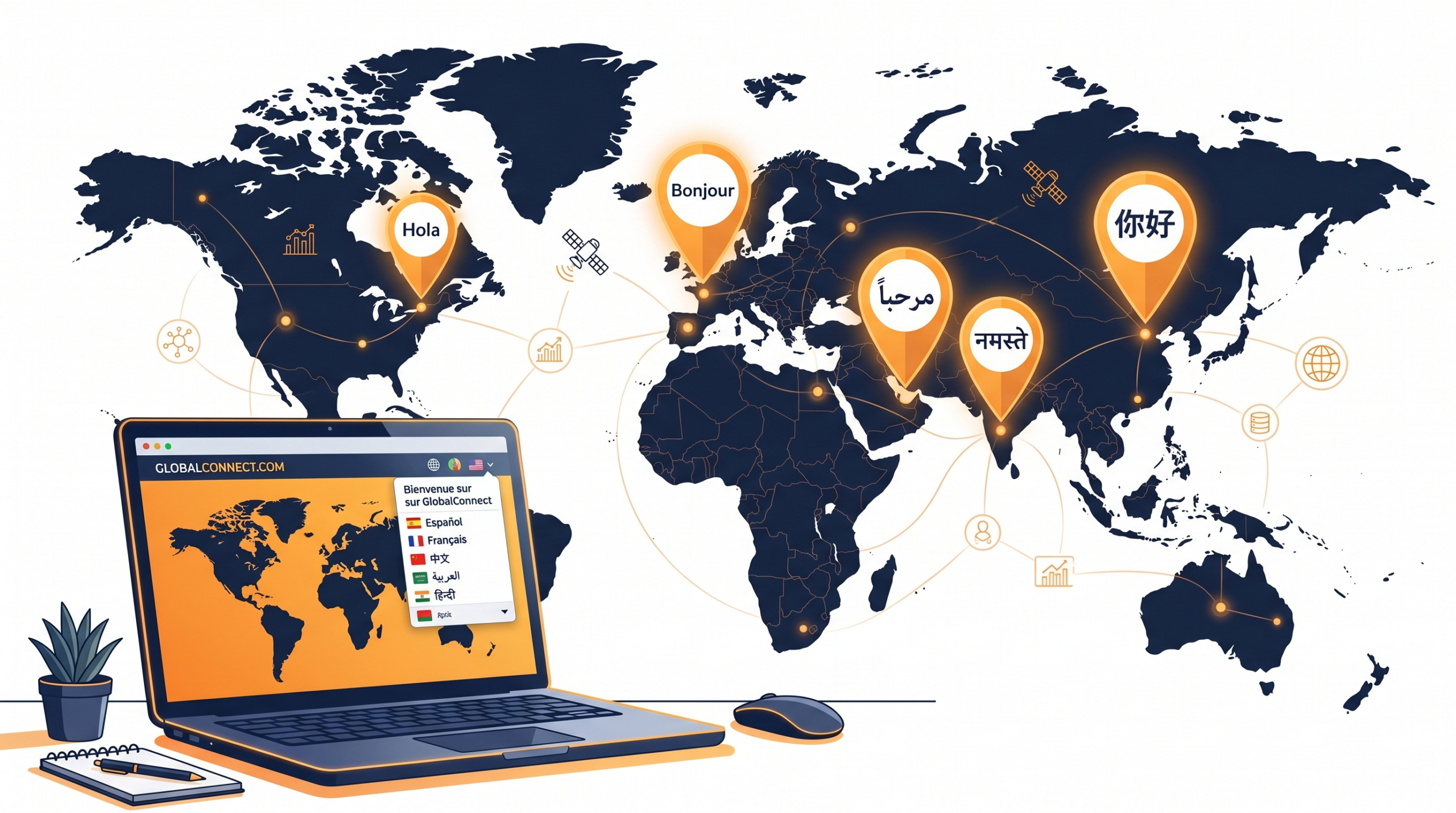
Top 5 languages to translate your website into in 2026 — Mandarin, Spanish, Arabic, Hindi and French
Choosing the right languages to translate your website into can unlock markets representing over 3 billion internet users worldwide.
Share this blog
Localization
World Languages

Top 5 Languages to Translate Your Website Into in 2026

By the Translationary Editorial Team  ·  5 Min Read  ·  Category: World Languages / Website Localization  ·  May 28, 2026


Knowing which languages to translate your website into is one of the highest-ROI decisions a growing business can make in 2026. Moreover, the right choices unlock markets representing billions of potential customers — while the wrong ones waste budget and miss the opportunity entirely.

In fact, if your site only speaks English, you’re closing the door on roughly three-quarters of the global internet audience. Website translation isn’t simply about swapping words between dictionaries. Rather, it’s about entering new markets with credibility, building trust with audiences who think differently, and capturing revenue that is, right now, going to competitors who bothered to show up in the right tongue.

65%
of people prefer content in their own language, even when they speak English
96%
of businesses report a positive ROI from localization efforts
40%
won’t buy from a website in a foreign language — full stop

These are not soft, feel-good numbers. For example, a DeepL-commissioned Forrester study found 65% of B2B leaders see at least a 3× return on localization investment. Additionally, Shopify data shows a 13% relative conversion lift when shoppers see a store in their native language. As a result, global ecommerce is pushing toward $6.8 trillion in 2026, and the fastest-growing markets — India, Southeast Asia, Latin America, the Middle East — are anything but English-first.


Why Knowing Which Languages to Translate Your Website Into Actually Matters

English is extraordinary. With 1.53 billion total speakers in 2026, it remains the world’s most widely used language for business, technology, and diplomacy. Furthermore, it accounts for roughly 49.6% of all website content — a jaw-dropping share, considering it’s the native language of only about 390 million people.

However, English dominates web content, but it does not dominate web users. In fact, English speakers represent just 25.9% of internet users worldwide. The other 74% are browsing, shopping, and making decisions in Mandarin, Spanish, Arabic, Hindi, French, and hundreds of other languages. Consequently, if your website speaks only English, you are invisible to the majority of the internet — by choice.

“A bilingual person who speaks Spanish and English can understand 1 in 3 people who connect to the internet — and access over 60% of everything published on the web.”

— Berlitz Global Language Report, 2026


How to Choose Which Languages to Translate Your Website Into

Not all translation projects are created equal. Therefore, before diving headfirst into five new language versions of your site, it’s worth pausing on three strategic questions. Businesses that answer these correctly get a far better return on their website localization investment.

1

Speaker volume and internet penetration. First, identify how many people speak the language globally and how many of them are online. A language with 300 million speakers and growing digital access can, in many cases, beat a 500-million-speaker language where internet infrastructure is still developing.

2

Geographic and economic opportunity. Additionally, consider which regions are growing fastest in your sector. For instance, the MENA region, Latin America, and South and Southeast Asia are driving outsized ecommerce growth in 2026. Aligning your roadmap with market momentum makes a significant difference.

3

Cultural fit and purchase behavior. Finally, remember that translation opens the door, while localization closes the deal. Understanding whether your target market expects formal or informal language — and how they prefer to pay — is equally important.


The 5 Best Languages to Translate Your Website Into in 2026

Based on internet penetration, ecommerce growth, market size, and localization ROI, here are the five languages that offer the strongest return. In short, these are the markets that most businesses looking to translate their website globally should prioritize first.

1

Mandarin Chinese

普通话 · 1.2 billion total speakers

🇨🇳

941M native speakers
19.8% of internet users
2nd largest online market
China · Taiwan · Singapore

No conversation about which languages to translate your website into starts anywhere other than Mandarin. With 941 million native speakers and 1.2 billion total speakers, Mandarin isn’t simply the second most spoken language in the world — it’s the native language of the planet’s most internet-connected nation. Specifically, China’s 888 million internet users represent nearly 20% of all global internet traffic.

Nevertheless, here’s the striking paradox: Chinese-language content makes up only about 1.2% of all websites. That gap, therefore, is a wide-open opportunity. Businesses that invest in professional Mandarin translation and localization are stepping into a relatively uncrowded space with enormous demand. Additionally, don’t overlook local payment integrations like Alipay and WeChat Pay.

2

Spanish

Español · 550+ million speakers

🌎

486–550M native speakers
8% of all web content
21 official countries
Fastest-growing US demographic

If Mandarin is the obvious big bet, Spanish is the surprisingly easy win. When you translate your website into Spanish, you instantly reach up to 550 million native speakers across 21 countries. Moreover, it ranks second among languages used for web content at approximately 8%, and covers most of Latin America — one of the world’s fastest-growing ecommerce regions.

Furthermore, don’t overlook the US market: Spanish is the most spoken non-English language in America, with over 41 million native speakers. As a result, a well-localized Spanish website — with regional variants for Latin America vs. Spain — could be the single highest-ROI translation project you undertake.

3

Arabic

العربية · 330+ million speakers

🌍

330M+ speakers
22 official countries
MENA: rapidly growing ecommerce
Right-to-left script

Arabic is the language of a region on the move. Spoken by more than 330 million people across 22 countries in the Middle East and North Africa, translating your website into Arabic opens access to one of the world’s most dynamic markets. In particular, the UAE, Saudi Arabia, and Egypt are driving explosive ecommerce adoption, while Gulf states boast highly educated, digitally savvy populations with strong purchasing power.

However, Arabic website localization is a full design challenge — Arabic is right-to-left, meaning your entire page layout mirrors itself. Nevertheless, done properly, it signals real commitment to the region and builds lasting brand credibility.

4

Hindi

हिन्दी · 609 million speakers

🇮🇳

609M speakers
3rd most spoken globally
India: 900M+ internet users
Fastest-growing digital economy

India’s digital transformation is one of the defining economic stories of the mid-2020s. With over 900 million internet users — second only to China — and a rapidly expanding middle class, India represents a generational market opportunity. Consequently, Hindi, with approximately 609 million speakers, is the key to unlocking the heartland of that growth when you translate your website for the Indian market.

It’s worth noting that India is linguistically diverse. While Hindi dominates in the north, Bengali, Tamil, Telugu, and Marathi hold significant sway in their regions. That said, a Hindi-first strategy covers the largest addressable audience. Above all, India’s ecommerce market is projected to reach $300 billion by 2030 — making it a priority for any global growth plan.

5

French

Français · 312 million speakers

🇫🇷

312M+ speakers
Official in 39 countries
Africa’s fastest-growing market
3rd in EU web content

French often gets underestimated when businesses decide which languages to translate their website into. However, French has official status in 39 countries — the highest of any language on this list — spanning Western Europe, Sub-Saharan Africa, North Africa, Canada, and the Caribbean. As a result, it offers remarkable geographic reach per translation dollar.

Furthermore, the really compelling story for French in 2026 is Africa — the continent with the world’s youngest and fastest-growing population. French is the dominant language of commerce and government across Côte d’Ivoire, Senegal, Cameroon, and the DRC. Combined with the mature European market and Canada’s Quebec, a French-localized website therefore casts an extraordinarily wide net.


One More to Watch: Portuguese

Portuguese narrowly missed our top five, but it still deserves serious consideration. Brazil alone has over 215 million people, a $60+ billion ecommerce market, and internet penetration climbing fast. In particular, if your industry has a natural fit with Latin American consumers — fashion, fintech, health, gaming — Brazilian Portuguese should be next on your website localization roadmap.


Before You Translate Your Website: Translation vs. Localization

Here’s the distinction that separates good global websites from great ones: translation converts words; localization converts customers. When you translate your website, you make it readable. When you localize it, however, you make it feel native — with adapted currency formats, payment methods, date styles, cultural references, and imagery that resonates locally.

Indeed, companies that invest in proper localization services (not just translation) see 25–70% increases in sales from new language markets, according to Weglot research across 110,000+ users. Ultimately, the difference between a translated page and a localized experience is the difference between a polite visitor and a loyal customer.

Ready to Choose the Right Languages to Translate Your Website Into?

At Translationary, we don’t just translate words — we localize experiences. Tell us your target markets and we’ll map out the smartest path to global growth.


Get a Free Consultation →

Related

Blogs

PDF accessibility remediation service — transforming inaccessible documents into WCAG compliant accessible files
Accessibility
Localization
Accessibility isn't just a technical checkbox — it's a language in itself. Here's how professional PDF remediation works, and why getting it right matters for every audience you serve. PDF accessibility remediation is the process every organization needs — yet few fully understand. Imagine spending weeks crafting a perfectly translated annual report, a multilingual compliance brief, or a localized product manual, only to discover that someone using a screen reader cannot access a single word of it. That gap between a well-translated document and a truly accessible one is, in fact, more common than most organizations realize. In this guide, we walk you through the exact steps involved in PDF accessibility remediation — taking a document from its raw, often inaccessible state to one that meets WCAG 2.1 and Section 508 standards. Moreover, we explain why each step is more nuanced than it looks, and why language expertise sits at the heart of the process. 1.3B People living with a disability worldwide 71% Of users with disabilities will leave an inaccessible site 96% Of top websites have detectable accessibility failures "A document isn't truly translated until every person — regardless of how they read — can access it." Why Most…
May 14, 2026
Localization
As we step into 2026, one trend becomes clearer every year: audiences are more global, more diverse, and more connected than ever before. Yet many businesses still communicate as if the world speaks only one language. At Translationary, we see firsthand how language shapes trust, accessibility, and brand credibility. And looking at the data, multilingual content is no longer a “bonus”—it’s a core part of how modern companies grow. Here’s why it matters now more than ever. People trust content in their own language A major global survey by CSA Research found that 76% of consumers prefer to buy from websites in their native language, while 40% said they would not make a purchase if the site wasn’t available in a language they understood. That’s almost half of all potential customers lost because of language barriers. When people read content in their own language, the experience feels natural. There’s less confusion. More confidence. They connect with the brand more easily. And that sense of comfort directly affects engagement and conversions. Localization leads to higher conversions Translation is one piece of the puzzle. Localization—adapting content to fit local culture, tone, and expectations—has an even stronger impact. Some companies have reported up…
February 10, 2026
World Languages
"As businesses continue to globalize, the demand for language services is at an all-time high. New market opportunities combined with advancements in technology are transforming industries worldwide. Language Services Providers (LSPs) play a crucial role in helping businesses break down language barriers, which is essential for expansion and effective communication. As we look ahead to 2025, let’s explore three key regions poised for significant growth in language services." 1. Africa: A Marketplace of Possibilities The African continent is on the brink of a trade revolution, bolstered by initiatives like the African Continental Free Trade Area (AfCFTA). This development is paving the way for a unified market, which, alongside the emergence of a robust tech ecosystem, is driving the demand for diverse language services due to several factors: 2. Asia Pacific (APAC): A Hub of Innovation and Growth The APAC region is witnessing an influx of foreign investments, particularly in developing areas of Southeast Asia. The Regional Comprehensive Economic Partnership (RCEP), which encompasses a significant portion of the global population, presents powerful opportunities for language service providers: 3. Eastern Europe and Central Asia: Navigating New Trade Landscapes Despite political tensions in certain areas, Eastern Europe and Central Asia are becoming attractive…
December 28, 2024