By the Translationary Editorial Team · 5 Min Read · Category: World Languages / Website Localization · May 28, 2026
Knowing which languages to translate your website into is one of the highest-ROI decisions a growing business can make in 2026. Moreover, the right choices unlock markets representing billions of potential customers — while the wrong ones waste budget and miss the opportunity entirely.
In fact, if your site only speaks English, you’re closing the door on roughly three-quarters of the global internet audience. Website translation isn’t simply about swapping words between dictionaries. Rather, it’s about entering new markets with credibility, building trust with audiences who think differently, and capturing revenue that is, right now, going to competitors who bothered to show up in the right tongue.
of people prefer content in their own language, even when they speak English
of businesses report a positive ROI from localization efforts
won’t buy from a website in a foreign language — full stop
These are not soft, feel-good numbers. For example, a DeepL-commissioned Forrester study found 65% of B2B leaders see at least a 3× return on localization investment. Additionally, Shopify data shows a 13% relative conversion lift when shoppers see a store in their native language. As a result, global ecommerce is pushing toward $6.8 trillion in 2026, and the fastest-growing markets — India, Southeast Asia, Latin America, the Middle East — are anything but English-first.
Why Knowing Which Languages to Translate Your Website Into Actually Matters
English is extraordinary. With 1.53 billion total speakers in 2026, it remains the world’s most widely used language for business, technology, and diplomacy. Furthermore, it accounts for roughly 49.6% of all website content — a jaw-dropping share, considering it’s the native language of only about 390 million people.
However, English dominates web content, but it does not dominate web users. In fact, English speakers represent just 25.9% of internet users worldwide. The other 74% are browsing, shopping, and making decisions in Mandarin, Spanish, Arabic, Hindi, French, and hundreds of other languages. Consequently, if your website speaks only English, you are invisible to the majority of the internet — by choice.
“A bilingual person who speaks Spanish and English can understand 1 in 3 people who connect to the internet — and access over 60% of everything published on the web.”
— Berlitz Global Language Report, 2026
How to Choose Which Languages to Translate Your Website Into
Not all translation projects are created equal. Therefore, before diving headfirst into five new language versions of your site, it’s worth pausing on three strategic questions. Businesses that answer these correctly get a far better return on their website localization investment.
Speaker volume and internet penetration. First, identify how many people speak the language globally and how many of them are online. A language with 300 million speakers and growing digital access can, in many cases, beat a 500-million-speaker language where internet infrastructure is still developing.
Geographic and economic opportunity. Additionally, consider which regions are growing fastest in your sector. For instance, the MENA region, Latin America, and South and Southeast Asia are driving outsized ecommerce growth in 2026. Aligning your roadmap with market momentum makes a significant difference.
Cultural fit and purchase behavior. Finally, remember that translation opens the door, while localization closes the deal. Understanding whether your target market expects formal or informal language — and how they prefer to pay — is equally important.
The 5 Best Languages to Translate Your Website Into in 2026
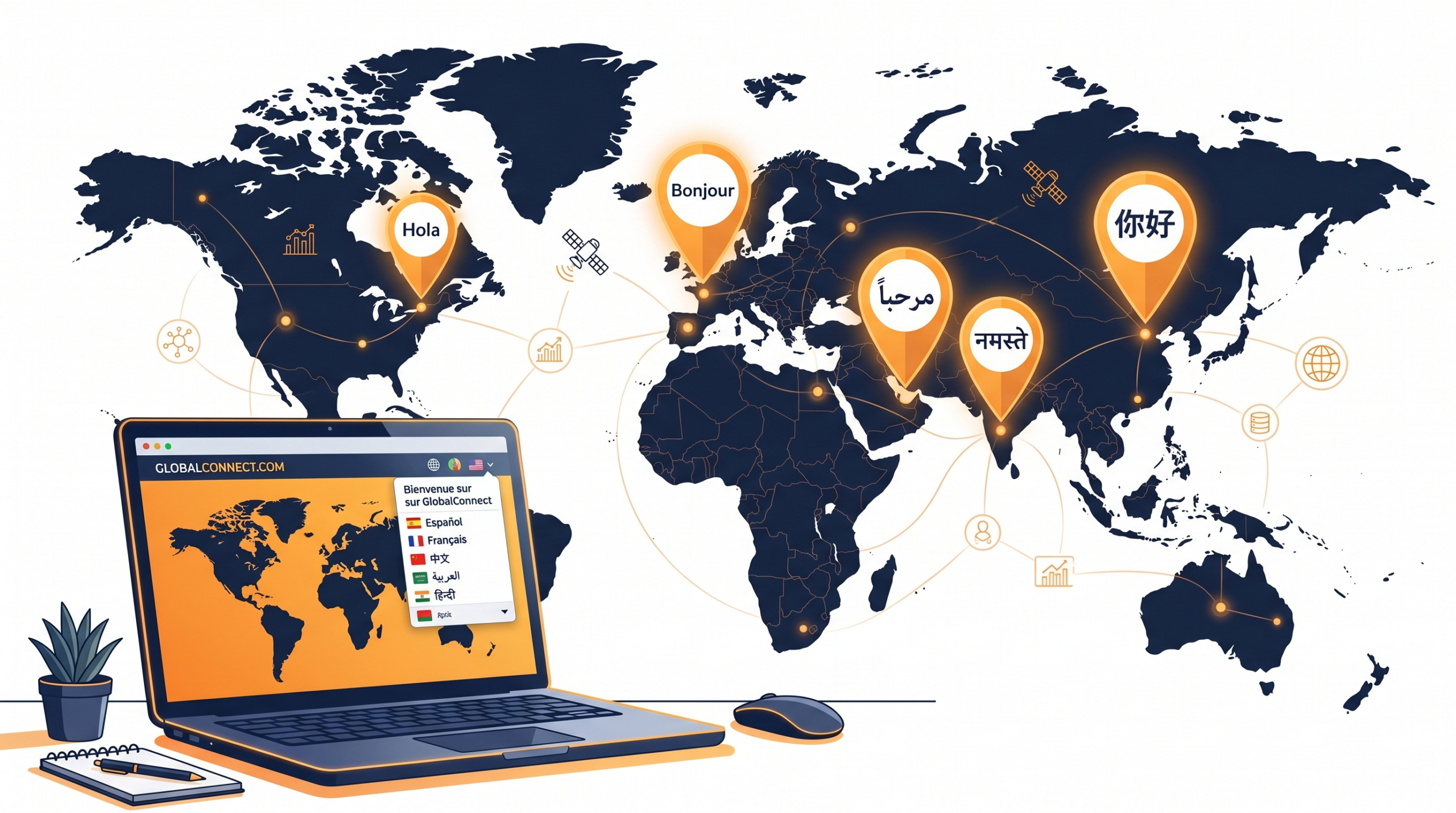
Based on internet penetration, ecommerce growth, market size, and localization ROI, here are the five languages that offer the strongest return. In short, these are the markets that most businesses looking to translate their website globally should prioritize first.
One More to Watch: Portuguese
Portuguese narrowly missed our top five, but it still deserves serious consideration. Brazil alone has over 215 million people, a $60+ billion ecommerce market, and internet penetration climbing fast. In particular, if your industry has a natural fit with Latin American consumers — fashion, fintech, health, gaming — Brazilian Portuguese should be next on your website localization roadmap.
Before You Translate Your Website: Translation vs. Localization
Here’s the distinction that separates good global websites from great ones: translation converts words; localization converts customers. When you translate your website, you make it readable. When you localize it, however, you make it feel native — with adapted currency formats, payment methods, date styles, cultural references, and imagery that resonates locally.
Indeed, companies that invest in proper localization services (not just translation) see 25–70% increases in sales from new language markets, according to Weglot research across 110,000+ users. Ultimately, the difference between a translated page and a localized experience is the difference between a polite visitor and a loyal customer.
Ready to Choose the Right Languages to Translate Your Website Into?
At Translationary, we don’t just translate words — we localize experiences. Tell us your target markets and we’ll map out the smartest path to global growth.